Latest News
My latest ramblings.
Enjoy! I definitely got important things to say


After losing his home during the 2014 earthquake in San Marcos on the Western region of Guatemala, José decided to start again by coming to Habitat for a new home. Having lived in a makeshift home out of tin and wood in a rented property, José then decided to commit to a new home and invest in the future. Because his sister had a great experience with a Habitat home a few years before, he decided to build his on a piece of land that his father, Benedicto, gave him.

“I feel at peace, and it’s nice to know that I am not working to pay for someone else’s future but for mine instead,” says José, smiling with his father while we sat in the kitchen. He moved most of his things into the house a few weeks after it was built. Jose still enjoys the single life and is slowly working to get the items that he needs to furnish his home. He plans on painting the walls, building a garage, and placing a fence on the land so that he can have a place for visitors to park in a safe area.

After showing me the stack of books in the front room, he says that now that he has the space at home he is able to spend his time preparing to be an English teacher, which is his passion. At the moment, Jose works at a call center in Xela, which is a two hour bus ride from his home. Regardless of the distance, he enjoys the commute and always takes a book along with him on the bumpy ride to keep his mind busy. “My favorite books are by Professor Ron Clark,” he says. “He writes on teaching to difficult students”.

José is very grateful, and after showing me the photos of the team that helped build his house, he mentions that he stays in touch with a few of the members through Facebook. After pondering for a moment he says, “Thank you for caring and taking the trouble to come down and help me build a home,” with a heartfelt smile on his face.

Now that he has his own space for living and studying, Jose can focus on his passion to teach others like him. It wouldn’t have been possible without the help of the hard work of the Habitat volunteers.

At seventy-two years old, Magdalena runs her household seamlessly. She rises early, tends to her sheep and goats, and then prepares meals for her daughter, Santos (35), and her two young grandchildren, Elmer (7) and Cedelia (5). She is also responsible for cleaning the family home.
Since receiving a Healthy Home Kit from Habitat Guatemala, life has become significantly easier for Magdalena and her family. She is especially pleased that she has more time to herself. In Kaqchiquel, a local Mayan language, she explains that, “Before, the stove used a lot of wood, and we would have to search for it every single day. Now, we only have to go three times a week, which gives me much more time, now that I’m older, to rest.”

Reflecting on her old stove, Magdalena says that, “it was no more than a few blocks stacked together with a grill laid on top. It was in bad condition. The grill was twisted so much that you couldn’t even put food on it.” Her eyes, lungs, and skin also suffered from the burning smoke, and the choking tendrils also left the little ones with a cough. “It was everywhere, and it blackened our roof.” She points above to the ceiling, where remnants of soot dangle, an ominous reminder of what her stove used to be.
The Healthy Home Kit has also boosted Magdalena’s spirits in ways that she had never imagined. The new latrine has offered her greater privacy, dignity, and comfort. Plus, it’s closer to the house. “It’s nice to not to have to share a latrine with two other families,” Magdalena says. “Our old latrine was only a dirt floor, and a piece of cloth to cover the opening. Nothing more. There was no privacy, and it was dirty.”

Lastly, finding a clean drinking source is easier than ever. Rather than having to boil copious amounts of water, Magdalena only has to go to the stream twice a week to fetch water from the stream and put it into the water filter. “The stomach pains have disappeared,” she smiles.
Magdalena is grateful for all that the volunteers´ dedication and stamina, and she reflects on their relationship fondly. “Our family supplied the materials, but the volunteers were the ones who made them into the latrine and the stove,” she explains. “We are very grateful for the team and with the services that they provided us. We don’t suffer anymore.”

Sandra (29) and her mother-in-law, Isabel (43) have a daily ritual. Together, they will congregate in the kitchen to prepare three meals for their family of five. For a long while, Sandra says, their cooking equipment was far from ideal. The family stove, decades old, was falling apart. “There were a lot of problems with the bottom and the grill,” she explains. “The old one was made out of dirt and was very, very small. It used way too much wood.”
She cites that the old stove posed many health problems for her family. “Because of the smoke, we had a lot of lung issues, and we always burned ourselves. It was especially dangerous with my baby, Luciano, who would grab everything.”
Since Habitat Guatemala volunteers built her new stove last June, Sandra is thrilled with the results. Excitedly, she explains that, “The new one uses less wood, is easy to use, and doesn’t let off as much smoke.”

A new stove is not the only thing Sandra and Isabel have benefited from. As part of Habitat Guatemala´s Healthy Home Kit Program, they were also latrine and water filter recipients. Sandra cites that the new latrine is a great improvement. “Our old latrine was made of bamboo rods. It didn’t offer a lot of privacy and was farther away from the house,” she says. “The new one is made well. It’s dry, easy to use. There aren’t any problems with smell or with sturdiness.”
As for water? Since switching to a water filter, Sandra has noticed that her family’s health has measuredly improved. Before, all five of them suffered from daily stomach problems, mainly to using a tinaja, or a large earthenware jug that is commonly used to store liquids in rural areas of Guatemala. Sandra also doesn’t have to boil water anymore and is happy with the facility of using a filter.
When asked about the group that came to build the stove and latrine, Sandra’s face brightens. “We thank you so much for the wonderful work that you did. We hope that you continue to help serve families like ours. Thank you.”

 There are stories of happiness and stories of triumph. Then, there is the story of Lorinda Cataju (40) and Juan Sician Chuc (40), a couple who confronted adversity with courage, dignity, and utmost determination.
It began three years ago, when their family fell on difficult times. As farmers, they depended heavily on their crop for sustenance. However, this particular season, the crop failed, going with it, their primary income. Soon, Lorinda and Juan’s savings dried up, and they lost their house. All of a sudden, they found themselves, and their five young children, Andy, Josue, Isabella, Luis, and Mateo, with no place to go.
With their most important asset gone, and little options, Lorinda and Juan had to make an enormous decision.
“We couldn’t give food to our kids,” Lorinda says, her voice wobbling. “What do you do when you can’t provide food to your children?”
In the end, they sent all five to an orphanage forty-five minutes away. “Once a month, we went to go see them,” Juan explains. “But it just wasn’t the same.”

Lorinda and Juan felt that they had hit rock bottom. Their living conditions were by no means adequate. “We were in a shack, covered in a nylon tarp. It didn’t have a roof, or sturdy walls. For three years, we were there. There was nothing for us there. No kitchen, no bathroom, no children.” Lorinda sighs, deeply unhappy at the recollection. “It was very difficult to live like this.”
However, she was determined to reunite their family once more. “I spoke with my husband,” recounts Lorinda. “I told him that we were going to save a little bit of money. Then, we were going to go to Habitat. And then, we were going to get our children back.”
They did just that. For the next three years, Lorinda and Juan saved. And saved. And saved. Although it took a whole year to process the paperwork, they were soon approved for their new home.
Flash forward to today. Resting upon a small, grassy hill is the family home, filled with five, giggling children and two happy parents. On the day we visit, the youngest, Mateo, is eager to give a tour of the house, pointing to the beds where he and his brothers sleep.

Lorinda beams at the sight. “It feels better to have a house at last, because at last, we have filled it with our children. Again, they can be with us.”
Juan adds, “We have a bit more time to ourselves. We can be secure. We have privacy. We have family.”


Last month, Habitat Guatemala set out for the town of Usumatlán, Zacapa with two intentions. The first would be to honor our late director, don Luis Samayoa, who passed away last October. The second would be to complete a house in less than twenty-four hours in honor of his memory. What transpired would be remembered as one of the most notable feats in our organization’s history.
Friday began sunny and dry under the Zacapa heat. Volunteers from all backgrounds, as well as Luis’s wife and two sons, gathered to watch the first brick laid. In front of an eager crowd, the first mason quickly spread a thick layer of mortar on the foundation. He juggled the brick in his hands, careful not to let it slip, and laid it gently down, pausing to make any adjustments with a level tool. Once the commemorative gesture was complete, the workers leapt into action, hurrying to mix thousands of more pounds of mortar before the twenty fourth hour was up.

The crew worked tirelessly. Throughout the day, they passed concrete into the new houses, stacked blocks, and tied rebar after rebar. Well into the evening, the Amway Colony thrummed with animation and a fierce, eager determination to finish the building earlier than expected. Thanks to the help of 200+ national Habitat Guatemala staff, national volunteers, and 50 members of the Foley Group build, the house was completed in a record eighteen hours, with construction terminating at 2:30 Saturday morning.
The next day, new homeowner Gabriela Vazquez and her son were provided the keys to their newly completed house. As a pivotal Habitat leader in her community, Gabriela is overjoyed to have a home in dedication, love, and memory of don Luis Samayoa.

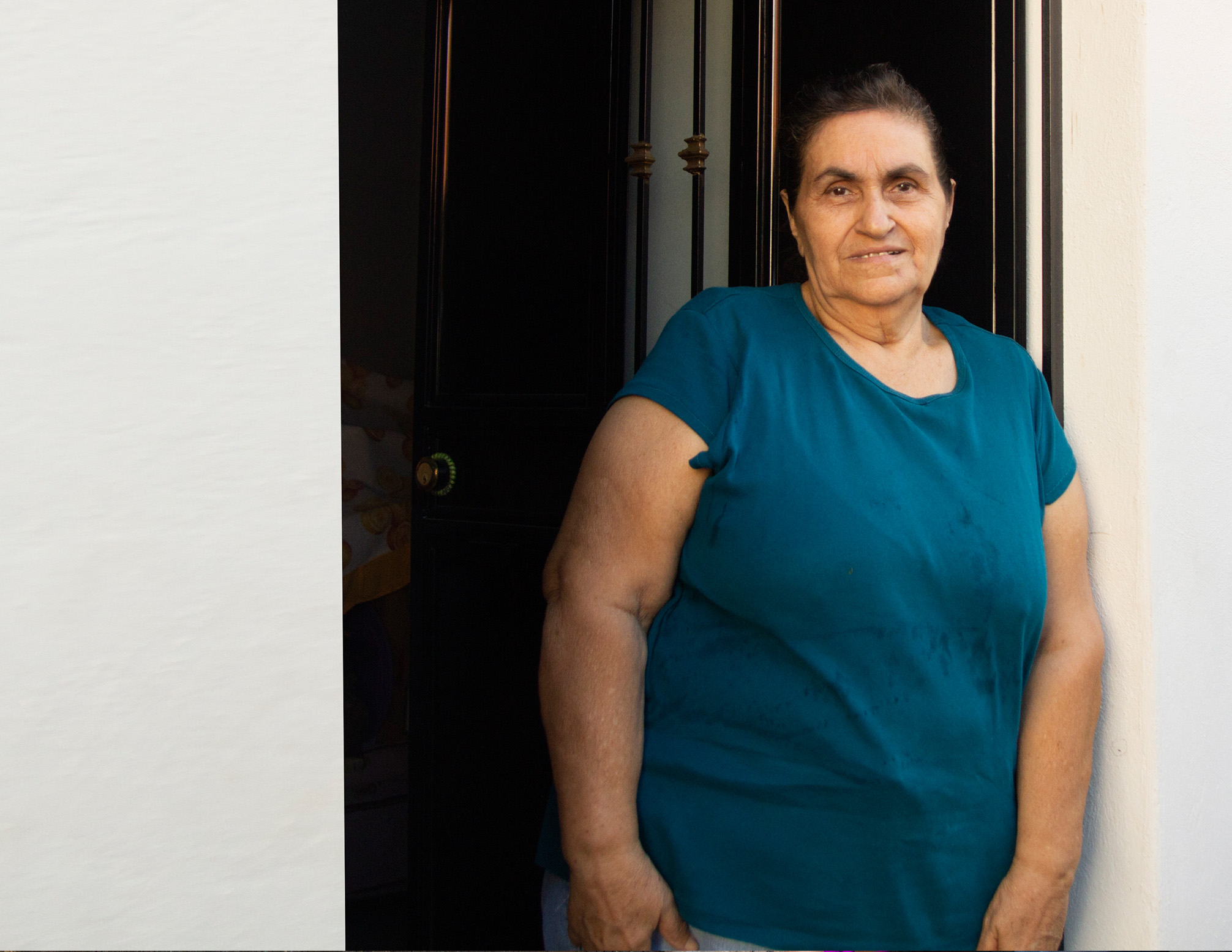

Juana Tobar’s yard is a rainbow. Corncobs fresh from the harvest are stacked one on top of another in shades of pale and deep yellows. Bright, green grass blankets the property and leads out to a freshly sown field, where the next season’s crops grow. Neighboring trees have begun to bloom brilliant red and purple flowers. Amidst the foliage, Juana shows us her wooden latrine, which stands quietly in the shade. “Our Habitat latrine is cleaner and steady,” she mentions to us. “Before, our old latrine was small and wobbly. There was no privacy, and it was made of a mix of bamboo pools and mud, which made it unsteady.”

Juana is meticulous when it comes to upkeep. One year after receiving a Healthy Home Kit, her smokeless stove, latrine, and water filter are in impeccable shape. Juana’s nine-year-old daughter, Soraya, drinks a glass of water from the filter tap while we speak. “The new filter works well,” Juana comments. “There was so much water to boil before, and now, it’s not a problem.”
Other tasks in her life have also become easier. Cooking tortillas is a nearly effortless process, and Juana can make twice as many as she could before on her old stove, which was dangerous and unreliable. “The grill was twisted, and we couldn’t cook with it effectively. The base was made of unsteady blocks,” she remembers. She also faced challenges with the smoke that it produced. “We had many health problems; we were always coughing. The smoke also would hurt my eyes a lot.”

She is pleased with the smokeless stove’s economic impact, too. “The new stove works well. It uses less wood, which saves us more time.” She laughs. “My husband and I have a deal now that, once a week, he will put on his gloves and go look for wood if I keep the stove clean.”

Juana has a special message for the group that came to help build with her one year ago: “I am very grateful for the work that you have done and the opportunities that you have provided us. May God bless you.”
Maria Candelaria, her husband, Alberto, and their three children, Wilfred, Glendy, and Cesar, live in the clouds. To reach their house from the town of Godinez, three steep hills, two farms, and a narrow, winding footpath stand in the way, proving daunting to new visitors. “Are you okay?” she jokes as we climb the final steps to her house, nearly out of breath. Seven-year-old, Wilfred and his younger sister, Glendy, giggle in unison at our red faces. “Did you know that the team who built our stove hauled the block machine all the way up here?” Maria laughs. “They were so strong!”

Despite her warm humor, Maria is serious when she describes why she needed a Healthy Home Kit for her family. She recognizes that living in a remote area has several disadvantages. Alberto is a construction worker who helps with major road projects and must leave his family for days at a time, leaving Maria to take care of the kids. She explains that every task in her daily routine, from bringing goods to and from the market to obtaining water can be a challenge. Especially while carrying her toddler, Cesar, on her back. She stresses that before she had a filter, there simply was no time to obtain clean water.

“We used to drink water directly from the stream, which is all the way down the hill,” Maria says. “It caused us so many stomach pains. We knew we were supposed to boil it, but it was hard, because we live so far away.” One year later, Maria is pleased with how much the new water filter has positively impacted her family’s life. “Now, if we want water, we can just get it from the tap. Although we have to go down to the stream once in awhile and take it up the hill, we can let it set on its own.”
Maria also speaks of how the wooden latrine has changed her routine.“Our old latrine had no roof,» she explains. «The booth part was made with bamboo poles and mud.” Not only is the new latrine closer to their house, but it is cleaner and offers privacy that was unavailable before. Glendy and Wilfred are also always excited to show it off to new visitors.

Lastly, when asked what her old stove was like, Maria shakes her head in disbelief. She describes the large quantities of smoke that used to leak out of the cracks from the blocks. “The chimney was in bad shape, and the grill was a mess. The children and I used to get a lot of headaches because the smoke was so strong.” She says that, after one year of use, her new stove has no structural problems. And the headaches have disappeared.
Maria and her children fondly remember the group that helped build the stove and latrine. Her message for them? “Thank you for giving us support. We don’t have very much, but what we have, we will save for you. We are so grateful to you for what you have done to help our family.”


Outside the bustling town of San Lucas Tolimán lies a smaller, quieter community. Home to 500 families, this place, named Xejuyu (pronounced “Shay-Who-You”), is inhabited by people who speak a kaleidoscopic mixture of the Maya indigenous language, Kaqchiquel, and Spanish. Here, neighbors easily recognize one another and take care of one another’s children as if they were their own.
Feliza Sulwi Chopen, mother of two students and proud owner of a Healthy Home Kit, has lived in this community her entire life. She cares for her house while her husband, Benjamin, is away working at a major farm down the road. Since she was a girl, Feliza has used a stove to support her family. “Here in Guatemala, the stove is life,” she explains.
However, like most women in Guatemala, Feliza has used an ineffective and dangerous stove for decades. When asked about her previous device, she recalls the many issues with its construction. “Our old stove was crooked, and because of that, a lot of smoke would come out and flood the house. The smoke would also stay in the house, and it was impossible to air out our rooms when that happened.” Access to clean air was also out of the question. “The stove always affected our health; we couldn’t breathe at all inside our house.”
After receiving materials to build a new stove this past May, Feliza’s family has already witnessed several positive economic and health changes. She gives us a quick financial breakdown of how the stove has impacted her life: “Since building the stove, we have cut back a lot on paying for wood. Now, we only need a little to heat up the entire grill and to cook our food. We can put three or four pots on top and cook for the entire family. For every two pieces of wood, that’s four pots of food for a whole family.” Mostly importantly, she says, “Saving money on firewood means one more piece of bread for our children.”
Feliza also notes that the water filter and latrine have contributed to a change in routine. Rather than boiling her water, she can readily access the supply in her filter and doesn’t have to worry about falling ill from waterborne diseases. She is also pleased with her family’s latrine, which is made of stone blocks and wooden beams. “Since building the latrine, we feel happier and cleaner. The air is pure, and we have a private space where there wasn’t one before.”

Matilda Tobar lives one house down from Feliza. While her husband works in the countryside, she is in charge of caring for her seven-year-old daughter, Paola, and the newest addition to the family, baby Brenaly. Like Feliza, she spends most of the day using a stovetop to prepare tortillas and meals for her family. Matilda is overjoyed that her new stove, which was built last May by a group of volunteers, is nothing like her old one. When remembering how the previous stove functioned, she shakes her head in disbelief.

“Our old stove was tiny! You couldn’t cook anything on it. The old kind, which almost everyone uses,
produces so much smoke and burns women and kids all the time. If you ask any of the women in this community, they can show you their scars from the burns.” In addition to the exterior risks, Matilda notes the stove’s negative impact on her family’s health. “My kids were always sick; my baby had a very bad cough for a long time, and we were always at the doctor, trying to get her help. She concludes: “Bad stoves are dangerous for everyone.”

The new stove has helped her family in many more ways than she realized. “We save a little money from not having to buy so much wood. Whatever we save, we give to our kids for school. We can buy them books, uniforms, whatever they need. Everything we do is always for our children.”
atención al cliente
QUETZALTENANGO
18 avenida 5-13 zona 3.
7736-8264 / 7763-7524 / 4740-6832
atención al cliente
GUATEMALA (REGIÓN GUATE-CENTRO)
3 Av. 8-26, Zona 10. Guatemala
23392223
atencionfamilias@habitatguate.org
© 2020 Habitat para la Humanidad ® Guatemala. | Desarrollado por iGuate.com